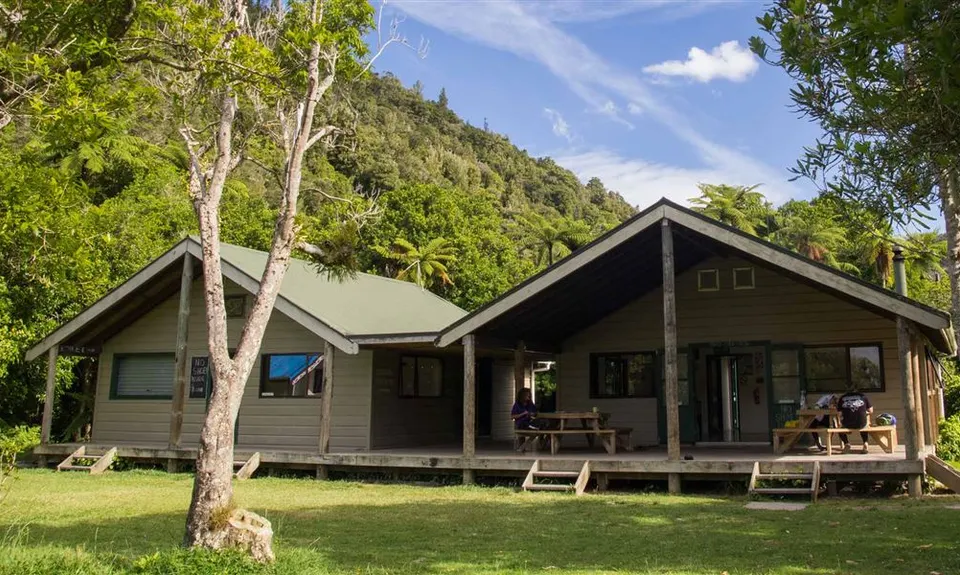
About this hut
During the Whanganui Journey Great Walk season, this hut operates as a Great Walk Hut. The Great Walk season is 1 October to 30 April.
Out of the Great Walk season this hut has no cooking facilities available. You need to bring your own cooker and utensils.
Tīeke Marae/Kāinga is a functioning marae
The marae as a whole sits at the core of a Māori person's cultural identity. Please respect these places as we share this experience after years of work together and through the cooperation of Te Whānau o Tīeke.
Te Whānau o Tīeke are the local committee made up of whānau, hapū, and iwi members that we work with here.
General tikanga (protocol)
You need to follow some simple rules around behaviour in and around the whare, pou (carved post), and Tīeke Marae/Kāinga or open courtyard space.
These rules are within Māori culture but are also based on respect, hygiene, and your own personal safety.
- You may be invited to participate in a pōwhiri (welcome) if whānau are present at the marae. The process will be explained to you. The marae ātea must be kept clear when visitors are going through the powhiri process. The marae ātea is the grassy area in front of the marae.
- The wharenui (ancestral house) is for local people only. Access into the wharenui is by invitation only. The wharenui is the meeting house on the marae ātea.
If in doubt about any rules or process feel free to approach your local hosts.
Koha (gift)
Money is preferred when giving koha. You can give your koha when you arrive. Koha here is usually between $10 and $30 dollars per person. For Tīeke Marae/Kāinga, any money given is used for the ongoing maintenance and upkeep of both the wharenui.
General rules
- All rubbish must be carried out.
- Smoking is only allowed outside, please keep the buildings smoke-free.
- Do not sit on tables, benches, or chilly bins. Do not sit on any surface that would come in contact with food.
Alcohol and drug-free
- Absolutely no alcohol or drugs allowed at Tīeke Marae/Kāinga and campsite. Medication is allowed.
There is a zero-tolerance approach to alcohol and drugs. You’ll be reported to the police if you’re intoxicated or suspected of using drugs.
Clothing rules
- Do not put anything that touches the body where food will be. This includes clothing, sunglasses, and shoes on things like picnic tables or benches.
It’s culturally inappropriate to put objects that have touched your body where food will be eaten.
- Remove shoes before entering any of the buildings. Leave shoes neatly on the deck. Shoes bring in dirt into shared spaces where people will sit and sleep
- Hang all wet clothing on the clothesline provided or away from the hut and whare. Do not hang washing on the decks or marae area.
Ask the local people if in doubt.
Facility use rules
- Kitchen facilities are not to be used for personal hygiene tasks. For example, washing clothing and brushing teeth. Use the washbasins outside for those purposes.
- Do not put tents up on the marae ātea, use the designated campsites.
Photos and filming
- No filming without approval from Te Whānau o Tīeke.
- You should ask for permission from Te Whānau o Tīeke before taking photos at Tīeke.
Tīeke Marae/Kāinga history
Carved pou depict revered ancestors of the people of this place and land.
A whare, no matter how big or small, regardless of whether it is carved or not, is the focal point for an extended group of families usually descended from a single ancestor.
Koha history
On visiting a marae and undergoing a formal welcome by Tangata Whenua or “People of the Land”, it is customary for visitors to give a koha. This is a contribution to the marae or the event or directly to the host whānau in the event of tangi or an unveiling.
Koha traditionally included bulk foodstuffs including meat, vegetables, birds or shellfish, and fish. This helped offset the host's responsibility to feed everyone in attendance. It could also include taonga like pounamu or greenstone and pakohe or whale bone.
In today’s times, koha is more commonly given in the form of money. This is easier to transport, doesn’t spoil, and gives the hosts the flexibility to meet their costs as they see appropriate.