About this hut
Heritage
In 1939 the Government built five huts, including Number Three Hut, along an old 1860s gold miners pack track from Canterbury to the West Cost.
Fabric
This three-roomed T shaped hut is clad in rough sawn vertical board and batten timber with a corrugated iron roof. The tongue and groove floor area is 33 sq. metres. The only lining is painted tar impregnated building paper between the sawn timber framing and the board and batten cladding. The hut has 16 bunks, 12 in the main room and 4 in the small T section.
At the rear of the hut there is a small porch storeroom with a metal top bench. The main room had a tin chimney, but this was removed in 1996 and now has a wood burner in its place. Removal of the chimney and placement of the wood burner are the only alterations to the original form.
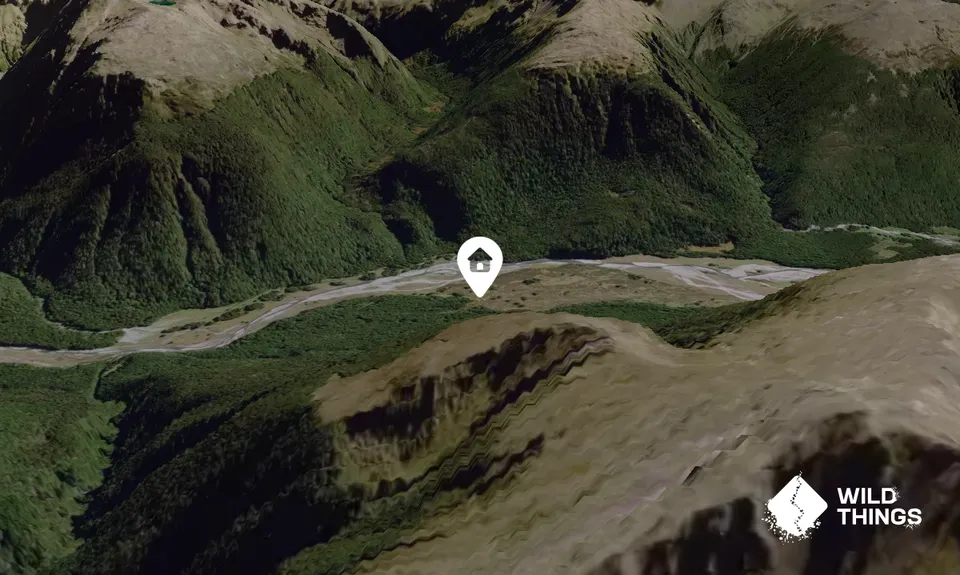
The hut is at 650 m above sea level on the Hurunui River (North Branch) valley floor and is surrounded by mixed beech forest.
History
One of a series of 5 huts built between Lake Taylor and Toms Creek on the Taramakau, of which only two remain, Number Three and Locke Stream Hut (Number Four). The hut at Lake Taylor (Number One) was shifted to Lake Taylor Station in 1994, Number Two was burnt down in 1996 and Number Five at Toms Creek was burnt down sometime in the early 1950s. The Physical Welfare Division of the Department of Internal Affairs provided funding to build the five huts.
The route on which the huts were located is an old 1860s gold miners pack track from Canterbury to the West Cost and was selected by the Government as a rival route to the Milford Track for tourists. It was envisaged that trampers and hunters would use the huts. Indications are that unemployed workers built the huts on a Depression Unemployment Board scheme.
Source: A guide to Lake Sumner Forest Park, 1982, NZ Forest Service.
Fabric significance
Example of early Government involvement in recreation and tourism in the area. Numbers 1, 2 and 3 huts were identical in design and construction. All had exterior vertical board and batten cladding and corrugated iron roofing.
Historic significance
Example of early Government involvement in recreation and tourism in the area. It is now the only remaining hut on the Canterbury side of the Main Divide on its original site, which makes it important.
Future management
The hut will be maintained to protect its historic fabric and minimise deterioration. The hut will continue to be used for recreation by trampers and hunters.
Facilities
Heating, Mattresses, Toilets - non-flush, Water from tap - not treated, boil before use, Water supply
Fees and bookings
Fees
- Adult (18+ years): $15 per night
- Youth (5–17 years): $7.50 per night
- Child/Infant (0–4 years): free
Before you go, buy Hut Tickets for each night's stay. Put these in the honesty box at the hut. Or buy a Backcountry Hut Pass that gives unlimited use at most Standard and Serviced huts for a 12 month period.
Te Araroa – The Trail Pass
Te Araroa Trail walkers should register and purchase the .