Sports drinks, fuel drinks, electrolyte drinks… what’s actually the difference?

Rob Bathgate
Yesterday at 12:15pm ShareWe stock a pretty ridiculous range of sports drinks and endurance fuels at Wild Things — and VIPs save 10–15% across the lot. So we figured it was probably time to actually explain why we have so many, what's different about them, and which one you might want in your flask.
Heads up: I’m a trail runner, not a sports nutritionist. This is my attempt to make sense of the packets.
Sports drink. Electrolyte drink. Endurance fuel. Race fuel. High-carb drink mix.
Whatever you call the stuff you tip into your soft flask, there are now a ridiculous number of options.
And, if I’m completely truthful, for a long time my understanding wasn't much more sophisticated than: this one tastes good, this one has heaps of calories, this one is expensive, and Tailwind seems to work for bloody everyone.
I've used many of them myself over the years, but recently I found myself standing in the storeroom reading the backs of packets and actually trying to figure out why we stock so many.
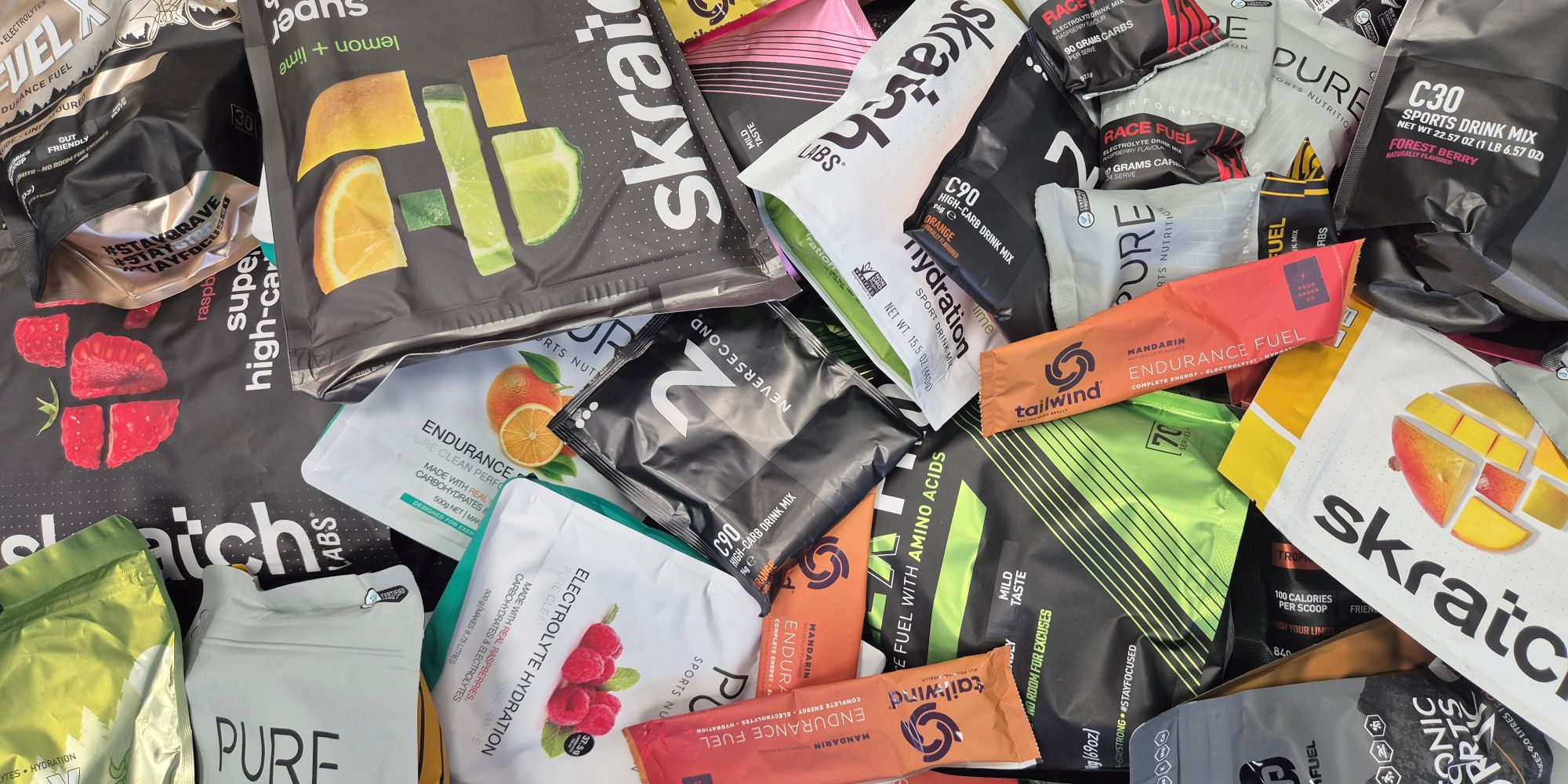
A bag of Tailwind Endurance Fuel, a sachet of Maurten Drink Mix 320 and a pouch of PURE Performance + Race Fuel are all essentially trying to do the same thing: get carbohydrate, fluid and usually some electrolytes into a runner - but they go about it in surprisingly different ways, and once you start reading the ingredients, things get quite interesting.
Sports drinks vs fuel drinks: are we drinking for hydration, or eating our lunch?
This is probably the biggest distinction.
Some sports drinks are primarily hydration drinks with a bit of carbohydrate. Others are genuinely food in a bottle.
Take PURE's standard Electrolyte Hydration. It's a fairly traditional sports drink: fluid, electrolytes and some useful energy along the way.
Skratch Sport Hydration Drink Mix sits in similar territory. It's deliberately relatively light on carbohydrate, with plenty of sodium and a light real-fruit flavour. It's there primarily to help replace what you're sweating out rather than trying to cram an entire hour's nutrition into your flask.
At the other end, PURE Performance + Race Fuel contains 90g of carbohydrate in one serve. Neversecond C90 also contains 90g. Maurten Drink Mix 320 contains 80g. Those aren't just flavoured hydration drinks. They're a serious chunk of your hourly nutrition.
Näak comes at it from yet another angle. Its Ultra Energy Drink Mix gives you around 55g of carbohydrate plus protein and electrolytes in a 250-calorie serving. It's less "sports drink" and more an attempt at liquid food for an ultra.
And then there's everything in between.
A rough comparison makes it easier:
| Product | Serving / mix | Carbs | Calories | Main carb sources | What it's really doing |
|---|---|---|---|---|---|
| PURE Electrolyte Hydration | 42g in 750ml | 37.5g | ~150 | Sucrose + glucose | Hydration + some fuel |
| Skratch Sport Hydration | 1 scoop in 350–500ml | 19–20g | ~80 | Cane sugar + dextrose | Hydration + some fuel |
| Tailwind Endurance Fuel | 2 serves in 590–710ml | 50g | 200 | Dextrose + cane sugar | Everyday endurance fuel |
| FIXX Fuel X | 55g in 500–700ml | 48g | 200 | Dextrose + sucrose | Everyday endurance fuel |
| Maurten Drink Mix 160 | 42g sachet in 500ml | 40g | 160 | Maltodextrin + fructose | Moderate-carb race fuel |
| Skratch Super High-Carb | 7 scoops in 600ml | 100g | 400 | Cluster Dextrin + fructose | Scalable high-carb fuel |
| Näak Ultra Energy Drink Mix | 72g in 500–750ml | 55g | 250 | Dextrose + maltodextrin + isomaltulose | Long-haul liquid nutrition |
| Maurten Drink Mix 320 | 83g sachet in 500ml | 80g | 320 | Maltodextrin + fructose | High-carb race fuel |
| PURE Performance + Race Fuel | 98g in 450–750ml | 90g | ~360 | Cluster Dextrin + fructose | High-carb race fuel |
| Neversecond C30 | 1 serving in 500-750ml | 30g | 120 | Maltodextrin + fructose | Modular endurance fuel |
| Neversecond C90 | 1 serving in 500–750ml | 90g | 360 | Maltodextrin + fructose | High-carb race fuel |
Already we're comparing quite different things — and all the different serving sizes and suggested dilutions make the actual numbers hard to compare. After all, you can make something give you twice as many carbs in the same 500ml soft flask simply by putting twice as much powder in.
If you're heading out for a cruisy 90-minute trail run and eating a bar or gel as well, you probably don't need 90g of carbohydrate sitting in your bottle.
If you're racing hard for hours and trying to consistently hit a high carbohydrate target, 20–40g in your bottle might be nowhere near enough.
That's really the first question to ask: is this drink helping hydrate me while I eat separately, or is the drink actually doing a big chunk of the fuelling?
And now we enter the sugar rabbit hole
This was the bit that got me turning packets around in the storeroom. You'd assume the fancy products contain some sort of space-age carbohydrate while the simpler ones are basically sugar.
Not necessarily.
Tailwind: remarkably simple
Tailwind Endurance Fuel uses dextrose (glucose) and cane sugar (sucrose).
That's pretty much the carbohydrate story.
Sucrose itself is made from glucose and fructose, so you're ultimately getting multiple types of simple carbohydrate without a huge ingredient list. Two scoops give 50g carbohydrate.
There's nothing particularly sexy about it, and that's possibly part of its success. The other part, at least here in NZ, is the incredible community Mark and Fibi built around Tailwind over the years. They backed events, runners and communities (including us at Wild Things) from day one, and deserve a huge amount of credit for making Tailwind what it is in NZ.
The product itself has plenty going for it too. It's easy to understand, easy to adjust and, for a lot of people, just works. You can make it stronger or weaker depending on what else you're eating, and the flavour doesn't tend to become completely horrific six hours into a run, and that's worth far more in the real world than an impressive-looking ingredients panel.
Fixx Fuel X: different packet, similar idea
Fixx Fuel X takes a similarly straightforward route.
Its carbohydrate sources are dextrose and sucrose, along with sodium, potassium, magnesium and calcium. One full serve gives around 48g carbohydrate and 200 calories.
Fuel X Pro is where the naming can get confusing (and always trips me up when remembering which packet to grab from the shelf...) It's basically Fuel X with L-alanine and L-leucine added. There are also caffeinated versions. The standard carbohydrate and electrolyte foundation remains much the same.
And it's made across the ditch in Queensland.
So Tailwind versus Fixx isn't really old-fashioned sugar versus futuristic carbohydrate technology. They're both relatively simple ways of delivering readily available carbohydrate plus electrolytes - which is absolutely not a criticism. Sometimes simple is exactly what you want.
PURE: three quite different drinks hiding under one brand
PURE gets interesting because its range covers almost the whole spectrum.
It's also the obvious one for anyone wanting to buy closer to home: PURE is a New Zealand company and its drink mixes are made here in NZ.
Their standard Electrolyte Hydration is the everyday sports drink of the range. It uses sucrose and glucose, real freeze-dried fruit and a mix of electrolytes. It's relatively light on fuel and easy to drink.
Then there's PURE Endurance Formula. This is exactly what got me around The WILD back in 2023.
This also uses sucrose and glucose, but adds New Zealand whey protein isolate. It's designed for longer sessions where you're starting to blur that line between hydration and nutrition.
That's quite an old-school endurance nutrition approach compared with the current obsession with cramming 90–120g of carbohydrate down your throat every hour — some carbohydrate, some protein, electrolytes, real fruit and keep ticking along.
Then you get to PURE Performance + Race Fuel, and suddenly we're playing a different game. This one contains 90g carbohydrate per serve, using Cluster Dextrin and fructose.
Which brings us to...
What the hell is Cluster Dextrin?
Cluster Dextrin — technically Highly Branched Cyclic Dextrin — is a carbohydrate made from starch with a different molecular structure from simple glucose or fructose.
It allows manufacturers to put a lot of carbohydrate into a drink without creating the same number of dissolved particles you'd get from an equivalent amount of simple sugar.
In practical terms, the aim is a high-carb drink that still empties from the stomach reasonably well and doesn't feel like you've mixed half a bag of icing sugar into your flask. Maybe this is why my sensitive stomach handles it really well without all those dashes into the bushes...
Does that mean Cluster Dextrin is automatically "better" than glucose or maltodextrin?
No.
If you're happily running for ten hours on Tailwind without stomach problems, great.
Where ingredients like Cluster Dextrin become interesting is when you're trying to push carbohydrate intake higher while still being able to run hard or without stomach issues. That's the niche PURE Performance + is aiming at.
And it's also where Skratch Super High Carb enters the picture.
Skratch uses Cluster Dextrin as its main carbohydrate source, along with a smaller amount of fructose. It's deliberately modular — the 100g carbohydrate mix in our table is seven scoops, but you can simply use less powder when you don't need that much fuel.
That's actually a nice illustration of why just looking at "grams per serve" can be misleading. Skratch isn't necessarily a lower-carb product than a 90g sachet of something else. You can simply change how much powder you're putting in the bottle.
The more useful question is always: how many grams of carbohydrate am I actually planning to consume per hour?
Maltodextrin isn't particularly fancy either
Then we have maltodextrin.
You'll find it in Maurten and Neversecond, amongst plenty of other endurance products, and one useful characteristic is that you can deliver plenty of carbohydrate without a drink becoming ridiculously sweet.
Both Maurten and Neversecond combine it with fructose.
Why?
Because the gut doesn't absorb all carbohydrates through exactly the same pathway. Glucose and fructose use different intestinal transporters, so combining them allows athletes to absorb and use carbohydrate at higher rates than relying heavily on glucose alone. Fancy huh.
This is why you see brands obsessing over glucose-to-fructose ratios when you get into high-carb race nutrition.
Maurten: the weird one
Maurten takes maltodextrin + fructose and adds its signature hydrogel technology.
And first, I finally learnt what their numbers mean.
Drink Mix 160 = 160 calories.
Drink Mix 320 = 320 calories.
Which equates to roughly 40g and 80g of carbohydrate respectively.
Thank you, Maurten. That is actually quite sensible.
Drink Mix 160 and 320 use maltodextrin and fructose, with the 320 designed to deliver a decent whack of carbohydrate in a single 500ml bottle.
Then Maurten adds sodium alginate and pectin, so when the drink hits the acidic environment of the stomach, Maurten says it forms a hydrogel which encapsulates the carbohydrate before it moves onwards to the intestine for absorption.
Whether you need that is another question.
But the real-life attraction is obvious. If you're trying to run hard while taking in 80g+ carbohydrate an hour, anything that makes that easier on your stomach is interesting.
Maurten also tastes unlike almost anything else here. There's no conventional fruit flavouring in the standard Drink Mix — just the slightly odd, neutral sweetness of the ingredients themselves.
Some people love that after hours of gels and fruit flavours.
Others take one sip and look deeply offended.
Neversecond: make the maths idiot-proof
Neversecond has possibly the easiest system to understand once you realise what the numbers mean.
C30 = 30g carbohydrate.
C90 = 90g carbohydrate.
Simple.
And just to clear up another bit of naming confusion: C30+ is their caffeinated gel, not another drink.
The C30 Sports Drink uses maltodextrin and fructose and gives you 30g carbohydrate per serving. Want 60g? Double it.
C90 takes the same basic high-carb approach and gives you the full 90g.
I quite like that modular way of thinking.
Rather than "one bottle equals one serving", think:
How many grams of carbohydrate do I want per hour?
How much am I drinking per hour?
How much sodium do I need?
Then build around that.
And a little NZ shout-out here too. Neversecond now has Mark, Fibi and their team behind it in NZ — the same crew who did such an epic job building the Tailwind community here. We're pretty excited to see what they do with Neversecond, and it's bloody good to have people like them backing our sport.
Näak: now we're basically drinking food
Näak Ultra Energy is another interesting outlier.
Rather than chasing maximum carbohydrate delivery, Näak is very obviously designed around being out there for a bloody long time.
A serving is around 250 calories with roughly 55g carbohydrate, but there's also plant protein and a decent electrolyte hit in there. The carbohydrate blend is interesting too: dextrose, maltodextrin and Palatinose (isomaltulose).
Isomaltulose is made from glucose and fructose, but the bond between them is broken down more slowly than ordinary sucrose. So rather than everything being about getting carbohydrate into the bloodstream as rapidly as possible, Näak is deliberately mixing faster and slower carbohydrate sources.
Again, that makes sense when you look at the problem it's trying to solve.
This isn't really a sub-three-hour marathon product. Näak talks about ultra marathons and multi-hour outdoor missions, and the inclusion of protein makes far more sense when you think about someone moving for 10, 15 or 20 hours.
There's also a very practical reason plenty of New Zealand trail runners should know what Näak tastes like.
It's served at Tarawera Ultra-Trail aid stations.
And that brings up something arguably more important than half the nutrition science in this article:
Try your race nutrition before race day.
If you're planning to rely on what's available at aid stations, find out what it is and train with it.
Don't get 70km into an ultra, fill both flasks with a drink you've never tasted before and discover your stomach absolutely hates it.
Even the best sports nutrition product in the world is a terrible race fuel if you've never actually tried running on it.
And where does Skratch fit?
Skratch is interesting because, like PURE, it effectively covers two completely different jobs.
Sport Hydration Drink Mix sits towards the hydration end. Simple carbohydrates, plenty of sodium, real fruit flavour and a relatively low amount of fuel.
It's the sort of thing that makes sense when you're getting most of your calories from gels, chews or actual food and primarily want your bottle to deal with fluid and electrolytes.
Super High Carb, on the other hand, jumps straight across to liquid fuelling.
Same brand. Completely different job.
Which really sums up this whole article.
So... which carbohydrate is best?
After reading all these packets, the slightly disappointing answer is:
It depends.
There's no obvious ladder where sucrose is rubbish, maltodextrin is better and Cluster Dextrin is the ultimate.
Tailwind and Fixx use remarkably simple carbohydrate sources and work brilliantly for loads of runners.
PURE and Skratch both offer lighter hydration products at one end and much more serious high-carb products at the other.
Neversecond and Maurten use maltodextrin + fructose to make higher carbohydrate intakes easier.
PURE Performance + and Skratch Super High Carb use Cluster Dextrin to attack the high-carb problem in another way.
Maurten adds its hydrogel system on top.
And Näak goes off in a slightly different direction again, mixing faster and slower carbohydrates with protein and electrolytes for genuinely long-duration fuelling.
The more useful question is probably what problem are you actually trying to solve?
If you're out running trails for a couple of hours and eating food as well, you may just want something tasty that supplies electrolytes and a steady trickle of carbohydrate.
If you're six hours into an ultra and surviving happily on Tailwind and cheese sandwiches, don't change anything because somebody on Instagram told you that you need 100g of carbohydrate per hour.
But if you're racing hard, struggling to eat enough, or deliberately trying to push towards 80–100g+ carbohydrate per hour, suddenly the high-carb products start making a lot more sense.
And if you're going really long, products such as Näak and PURE Endurance start asking a slightly different question again: should there be a bit more than just carbohydrate and salt in the bottle?
Your gut gets the final vote.
What I'd actually choose
I'm special. Years ago I drank some nasty water from a stream in the Kaimais and ended up with yersinia enterocolitica. For years my stomach hated most rich or strong foods and drinks - gels would be leaving my body before they even entered my mouth, and it was always my guts that gave way before my legs.
Steadily, things have got better, and I've found the PURE Performance + Race Fuel works really well for me, so I'll use it even on the mid-length runs (think 2+ hours). Most likely due to that Cluster Dextrin. But, I can now also stomach Tailwind, and when my last bag of that runs out, I'm grabbing myself some Neversecond to try.
Oh, and when just hot and sweaty, on a short run around the estuary, I usually pop a scoop of Peak Fuel Hydration in my bottle. Some electrolytes, but mainly because the Cola flavour reminds me of those frozen cola ice blocks I used to get from the dairy as a kid... It, along with PURE, has the added bonus of being made here in NZ.
They're not necessarily "better sports drinks" - they're solving a harder, personal fuelling problem. And I think that's ultimately why we've ended up with so many different bags sitting on the Wild Things shelves.
They look like variations of the same thing. They're not.
The trick isn't finding the cleverest carbohydrate or the packet with the most science written on the back.
It's figuring out how much fuel you actually need, how you want to carry it, what else you're going to eat — and, most importantly, what your stomach is still happy to deal with when you've been running for six hours.
Because 90 grams of scientifically optimised carbohydrate isn't much use when you're sitting beside the trail trying not to spew it back up.
You can find the drink mixes in the Wild Things shop, with the VIP price shown on each product. Pick something that fits your run, then give it a proper go in training.